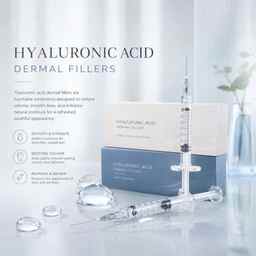
Hyaluronic acid dermal filler
Hyaluronic acid dermal fillers
A class of injectable gels that add or restore volume; each product is approved or licensed for specific tissues, depths, and treatment areas.
Hyaluronic acid dermal fillerReviewed 7/30/2026Source recorded
At a glance
| Primary purpose | Product-specific correction or augmentation of approved facial or hand areas by adding gel volume. |
|---|---|
| Mechanism | An implanted hyaluronic acid gel occupies space in soft tissue; formulation, cross-linking, concentration, particle properties, and injection plane differ by product. |
| When results appear | Volume change is visible immediately, with assessment refined after early swelling settles. |
| Typical sessions | Often one visit with possible staged treatment or touch-up; amount and number of sessions depend on product, area, and goal. |
| Downtime | Usually limited social downtime, but swelling, tenderness, redness, and bruising can be conspicuous for days and sometimes longer. |
| Longevity | Product- and area-specific. FDA consumer guidance gives roughly 6 to 12 months for many absorbable HA fillers, while some approved products have longer study follow-up. |
| Reversibility | Many HA fillers can often be reduced with clinician-administered hyaluronidase, but this use is off-label in the US, response varies, and complete reversal is not guaranteed. |
| Documented risks | Swelling, bruising, pain, tenderness, lumps, infection, inflammatory reactions, and rare inadvertent intravascular injection causing tissue necrosis, vision loss, or stroke. |
| Most common disappointment | The wrong product, amount, or placement can look overfilled, fail to address the actual cause, or require more than one syringe. |
| Common marketing misconception | Dermal fillers are not one interchangeable product and are structurally different from Botox. |
| What varies by provider | Diagnosis, product selection, injection plane, amount, cannula or needle choice, vascular safety technique, and complication readiness. |
| Skin-tone considerations | Filler is not selected by skin tone alone, but bruising, inflammation, and post-inflammatory pigment change may present differently; product labelling and injector experience still matter. |
| When this treatment may not be appropriate | Avoid when product contraindications apply, at infected or inflamed sites, or when the goal requires muscle relaxation, skin resurfacing, or surgery rather than volume. |
| United States regulatory status | The FDA approves dermal fillers product by product and for specific indications; the HA-filler class itself is not a single approved product. |
| Canadian regulatory status | Health Canada licenses HA filler devices product by product through MDALL for Class III devices; class-level status does not establish a licence for every brand or indication. |
| Evidence status | High for class mechanism, product-specific regulatory model, common reactions, and vascular risk; duration and suitability must remain product- and area-specific. |
Sources
- FDA-Approved Dermal FillersFDA device guidance · regulatory-primary · supports 3 profile fields
- FDA: Dermal Filler Do's and Don'tsFDA consumer safety guidance · regulatory-primary · supports 7 profile fields
- FDA: Dermal Fillers (Soft Tissue Fillers)FDA device guidance · regulatory-primary · supports 15 profile fields
- Health Canada Medical Devices Active Licence ListingHealth Canada regulatory guidance · regulatory-primary
- The use of hyaluronidase in aesthetic practicepeer-reviewed review · peer-reviewed-secondary
Related comparisons
See average treatment prices near you
Enter a US ZIP code or Canadian postal code to check our stored estimate for the surrounding market.